
Best EV Scooter Under ₹1 Lakh in India 2026 — Top Picks
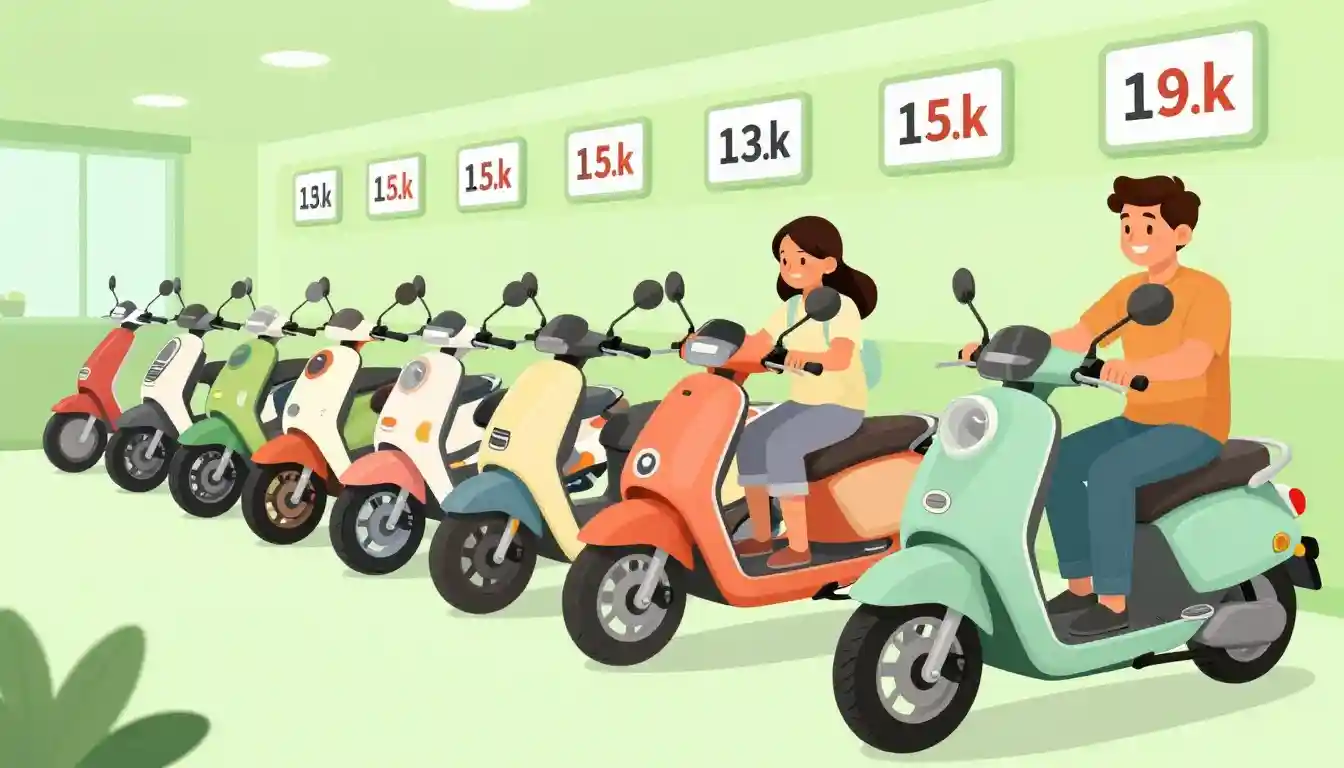
A budget of ₹1 lakh is enough to buy a genuinely good electric scooter in India in 2026, not a toy and not a compromise. The market below the ₹1 lakh mark has matured: you can now choose between big-brand reliability (Ola), battery swapping (Bounce Infinity), value-focused local makers (Pure EV) and a fast-growing Hero lineup. We reviewed every strong contender under ₹1 lakh with honest real-world range figures, the subsidy maths for your state, and clear verdicts for different kinds of riders. We use ex-showroom Delhi prices from August 2026, and we flag exactly where each scooter stands after state subsidies, because in Delhi several of these drop below ₹65,000 on-road.
The Contenders at a Glance
Five scooters dominate this price band in 2026. The table below compares them on price, battery, advertised range, realistic city range, and who each one suits best.
| Scooter | Ex-showroom | Battery | Advertised range | Real range | Best for |
|---|---|---|---|---|---|
| Ola S1 X (2 kWh) | ₹84,999 | 2 kWh | 85 km | 60–70 km | Budget buyers, short commutes |
| Bounce Infinity E1 | ₹89,999 | 2 kWh | 85 km | 55–65 km | Riders without home charging |
| Pure EV EPluto 7G | ₹92,999 | 2.5 kWh | 90 km | 60–70 km | Budget + extra range headroom |
| Ola S1 X (3 kWh) | ₹97,381 | 3 kWh | 125 km | 85–100 km | All-round daily use |
| Hero Vida VX2 Go | ₹99,490 | 2.2 kWh | 95 km | 60–75 km | Hero's service network and features |
Note that the "real range" column uses the industry-standard rule: actual mixed-city range is roughly 55–70% of the advertised figure. Plan your daily travel around the real number, and you will never face an empty battery mid-commute.
Top Pick: Ola S1 X (3 kWh) — ₹97,381
This is the scooter most people should buy in this budget. The 3 kWh battery delivers a genuine 85–100 km in mixed city riding, which covers a 20–25 km daily round trip for nearly a week on one charge. It carries Ola's features, app control, keyless start, cruise control, tyre-pressure monitoring, and the largest fast-charging network in the country, which matters if you occasionally ride beyond the city. Insurance and registration push the no-subsidy on-road price just past ₹1 lakh, so it sits at the very edge of this budget band; in Delhi it is comfortably inside. The known weaknesses are long service queues in some metros and the fact that the company's pricing has shifted several times, so always confirm today's quote.
Best Strict Budget: Ola S1 X (2 kWh) — ₹84,999
If the ceiling is firmly ₹85,000, the 2 kWh S1 X is the best combination of brand, features and price. Real-world range of 60–70 km is enough for a 10–15 km daily commute plus errands, and it charges from a normal wall socket overnight. It is also the strongest subsidy play of the group: in Delhi, the Year 1 benefit (₹20,000 purchase subsidy + ₹10,000 scrap bonus + free road tax and registration) puts it on the road at about ₹60,000, the cheapest meaningful EV scooter you can buy from a major brand in 2026. The honest caveat: at 2 kWh, you will charge more often, and cold weather and highways cut range noticeably.
Best Without Home Charging: Bounce Infinity E1 — ₹89,999
Most EV buyers have one unanswered question: where do I charge it in an apartment? The Bounce Infinity E1 answers with battery swapping. Ride in, swap an empty battery for a full one in under a minute at Bounce kiosks. You can also buy it without the battery (the battery is rented through a subscription), which drops the purchase price sharply and removes the battery-degradation worry entirely. The trade-offs are real: swap subscriptions add a monthly cost, the scooter's build feels more basic than the Ola, and the network is concentrated in a few large cities. If swapping stations exist on your regular routes, this is the only sane pick for a flat dweller.
Best Value Battery: Pure EV EPluto 7G — ₹92,999
The EPluto 7G quietly does what budget buyers need: a 2.5 kWh battery, 25% bigger than the 2 kWh class, for under ₹93,000, with a simple, easy-to-maintain design and Pure EV's growing service footprint in tier-2 and tier-3 cities. Its 60–70 km real range is similar to the S1 X (2 kWh), but the extra capacity means gentler battery stress on the same daily run, which helps long-term battery health. It is slower than the Ola at the top end and lacks the app-based features, but for buyers who value simplicity and repairability over gimmicks, it is the sensible money pick.
Best Hero Option: Hero Vida VX2 Go — ₹99,490
Hero MotoCorp's Vida VX2 Go sits just under the ₹1 lakh line and brings the largest two-wheeler service network in India to the electric segment, a genuine advantage outside metros. It offers a 2.2 kWh battery with 60–75 km of real range, a removable battery option that eases apartment charging, and Hero's fit-and-finish quality. On price per kilometre of real range it is not the best value on this list, but if your buying criteria are network coverage, brand trust and the removable-battery flexibility, it deserves a test ride. Check whether your local Hero dealer has trained EV technicians before booking.
The Subsidy Factor: What These Cost in Delhi
Prices above are ex-showroom. In Delhi's Year 1 policy (₹10,000 per kWh, capped at ₹30,000, plus ₹10,000 scrap bonus, free road tax and registration), the same scooters land on the road at dramatically lower numbers. Insurance is estimated at 6% of ex-showroom.
| Scooter | Ex-showroom | Delhi subsidy | Scrap bonus | On-road in Delhi |
|---|---|---|---|---|
| Ola S1 X (2 kWh) | ₹84,999 | −₹20,000 | −₹10,000 | ~₹60,099 |
| Bounce Infinity E1 | ₹89,999 | −₹20,000 | −₹10,000 | ~₹65,399 |
| Pure EV EPluto 7G | ₹92,999 | −₹25,000 | −₹10,000 | ~₹63,579 |
| Ola S1 X (3 kWh) | ₹97,381 | −₹30,000 | −₹10,000 | ~₹63,224 |
| Hero Vida VX2 Go | ₹99,490 | −₹22,000 | −₹10,000 | ~₹73,459 |
The striking result: four different scooters with different strengths converge in the ₹60,000–65,500 band on-road in Delhi, because the subsidy scales with battery size. That narrows the price difference between the 2 kWh and 3 kWh Ola to barely ₹1,100 on-road, which is why our top pick is the 3 kWh model: the extra ₹12,000 of battery costs you almost nothing after the subsidy. In states without a purchase subsidy, the price ladder reverts to the ex-showroom numbers, and the 2 kWh Ola becomes the value pick again.
Which Scooter Fits Which Rider
All five scooters are good, which is exactly why choosing one is hard. The decision table below removes the guesswork: find your riding profile in the left column and read across for the pick that matches it. The reasoning is the same in every row: charging access decides whether swapping matters, daily distance decides the battery size, and service network decides how happy you stay for the next five years.
| Your situation | Best pick | Why |
|---|---|---|
| Apartment dweller, no parking socket | Bounce Infinity E1 | Only option that solves charging in under a minute |
| 10–15 km daily commute, tight budget | Ola S1 X (2 kWh) | Big brand, features, lowest entry price |
| 15–30 km daily commute | Ola S1 X (3 kWh) | Charges every 3–4 days, all-round best value |
| Tier-2/Tier-3 city, simple servicing | Pure EV EPluto 7G | Easy maintenance, growing small-city network |
| Brand trust and removable battery | Hero Vida VX2 Go | Hero's dealer network plus battery you can carry up |
One final note on the trade-off between the 2 kWh and 3 kWh Ola versions: the 2 kWh model makes sense only when the budget is truly tight. In every other case the 3 kWh version's double range costs just ₹12,382 extra ex-showroom, and in Delhi, after the subsidy, the gap collapses to about ₹1,100. Range is the feature you cannot retrofit later; buy it at the start.
What to Check Before You Sign
- Charging reality: Can you plug in at home or work? If not, add the swap network question before choosing.
- Battery warranty: Compare the warranty terms in writing, 3 to 8 years depending on brand. Longer is worth real money.
- Service proximity: For each candidate, ask the nearest service centre's address and spare-part availability. This decides your happiness more than top speed.
- Invoice subsidy line: In subsidy states, the discount must appear on the invoice, and the Delhi claim must be filed within 30 days of the RC.
- Real test ride: Range figures are estimates; ride the actual route you will use daily, at the speeds you really ride, before deciding.
Under ₹1 lakh in 2026 you are not buying a compromise, you are choosing between five genuinely different answers to the same question. Decide on charging access first, range second, and network third. The subsidy will take care of the price.
FAQs
Which is the best EV scooter under ₹1 lakh in 2026?
The Ola S1 X (3 kWh) at ₹97,381, the best combination of real range (85–100 km), features and brand network. For strict budgets, the Pure EV EPluto 7G at ₹92,999 is the value pick.
Can I get a good EV scooter under ₹70,000 in Delhi?
Yes. After the Delhi Year 1 subsidy and scrap bonus, the Ola S1 X (2 kWh) is about ₹60,099 on-road and the 3 kWh version about ₹63,224.
Which sub-₹1 lakh EV scooter has the longest real range?
The Ola S1 X (3 kWh), with 85–100 km of real mixed-city range. The Hero Vida VX2 Go delivers 60–75 km; the rest sit at 55–70 km.
Is battery swapping cheaper than home charging?
No. Swapping costs roughly ₹1.50–2.50 per km against ₹0.27 per km at home. Swap only when you cannot charge at home or need instant range.
Should I buy the 2 kWh or 3 kWh Ola S1 X?
In Delhi the subsidy nearly cancels the price gap, so take the 3 kWh for double the real range. In states without a subsidy, the 2 kWh version is the better value if your commute is under 15 km.